
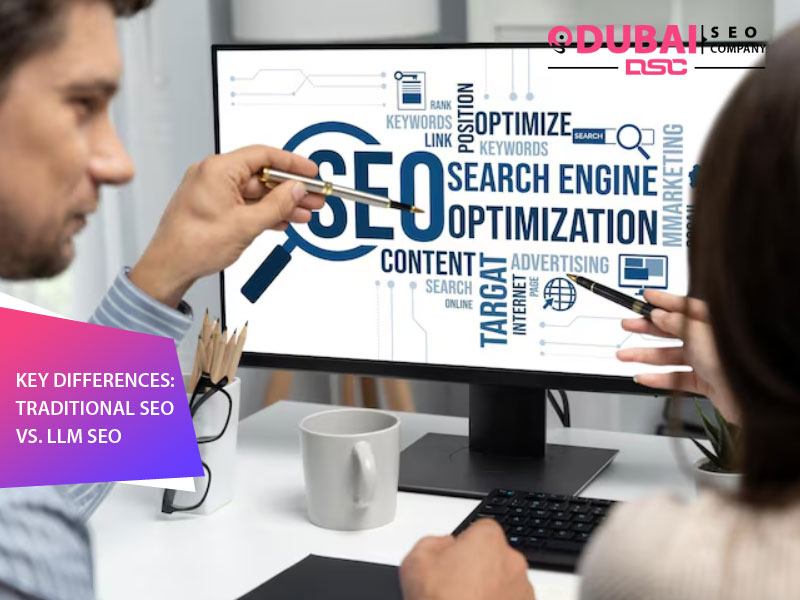
Search engines have long worked by listing pages and letting people choose between them. AI tools such as ChatGPT, Gemini and Perplexity work differently: they read from many sources and write a single reply. That change has given rise to LLM SEO optimisation, a practice that runs alongside the SEO most websites already follow.
The two share some groundwork, but they aim at different results and are judged by different measures. This blog explains how traditional SEO and SEO for AI differ, compares them in a table, and outlines what businesses investing in SEO Dubai can do to stay visible in both.
What Is Traditional SEO?
Traditional SEO helps a website rank higher in search results (mostly on Google). Someone types a query, scans the listed links, and picks one. SEO aims to make your page the one they pick.
The process often starts with an audit to check
- Crawl Errors
- Page Speed
- Mobile Usability As Well As
- Metadata
Next is keyword research so each page targets terms real people use.
On-page work then takes care of
- Titles
- Headings
- Copy As Well As
- Internal Links
Other than that, technical fixes make sure the site is easy for search bots to read. Track results through keyword positions, organic traffic as well as enquiries. Because search engines reassess sites over time, progress tends to build steadily rather than overnight.
What Is LLM SEO Optimisation?
LLM SEO optimisation is the process of shaping your content so large language models can understand it, trust it and mention it when they answer a question. Instead of competing for the third position on a results page, you compete to be named or cited inside a generated answer.
Large language models do not rank pages in a list. They draw on training data and, in many tools, on live retrieval of web pages, and then write a reply in plain language. Content that is clear, factual, well structured and linked to a recognisable brand is easier for these systems to use.
Two related terms often come up here. Answer engine optimisation (AEO) focuses on giving direct, concise answers to specific questions. Generative engine optimisation (GEO) focuses on earning a place in AI-generated responses. Together, they form the core of SEO for AI.
Traditional SEO vs. LLM SEO: Comparison Table
| Factor | Traditional SEO | LLM SEO |
|---|---|---|
| Primary goal | Rank pages higher in search results | Get the brand or page cited in AI-generated answers |
| Search interface | List of links | Conversational answers and summaries |
| Typical query | Short keywords | Longer, natural-language questions |
| Content focus | Keyword-targeted pages | Direct answers, clear facts, defined entities |
| Key signals | Backlinks, relevance, page speed, on-page elements | Authority, consistency across sources, structured content, clarity |
| Success metrics | Rankings, organic clicks, conversions | Brand mentions, citations, referral visits from AI tools |
| User behaviour | Clicks through to the website | May receive the answer without visiting |
| Timeline | Commonly 3 to 6 months for visible movement | Gradual, and depends on how often your brand is referenced |
The table shows that the two approaches ask different questions. Traditional SEO asks, “Where does my page appear?” LLM SEO asks, “Does an AI tool know my brand well enough to mention it?” Both questions matter, and a business that ignores either leaves visibility on the table.
Where the Two Approaches Overlap
LLM SEO does not replace what you already do. It builds on it.
A page that search engines cannot crawl is unlikely to be retrieved by an AI tool either. Fast loading, a clean site structure and mobile-friendly design help both. Quality content written with real experience also helps both, since search engines and language models alike favour material that is accurate and useful.
Backlinks and brand mentions on reputable websites strengthen your authority in each case. In short, strong traditional SEO gives LLM SEO a solid base to grow from.
How to Optimise Content for AI Search
You can improve your chances of appearing in AI answers with a few practical steps:
- Use question-led headings. Phrase headings the way people ask questions, such as “How much does SEO cost in Dubai?”
- Answer first. Place a short, direct answer of 40 to 60 words under each heading, then expand with detail.
- Add structured data. Schema markup for your organisation, articles, FAQs and local business details helps machines read your pages correctly.
- Keep brand details consistent. Your business name, address and phone number should match across your website, Google Business Profile and directories.
- Publish original insight. First-hand experience, clear process explanations and local examples give models something worth citing. Generic text rarely does.
- Refresh older pages. Update statistics, services and examples so your content stays accurate.
- Earn mentions on credible sites. Ethical, white hat link building as well as genuine brand references help AI tools recognise your business as a reliable source.
None of these steps work as a shortcut. They work best when applied together and kept up over time.
Why SEO Dubai Businesses Should Act Now
Dubai is a busy market. Real estate, healthcare, finance, retail, and hospitality brands all compete for the same searchers, and many now ask AI tools for local recommendations before visiting a single website.
Local intent plays a large part in this. A person asking for a dental clinic, a logistics provider or a restaurant expects a specific, nearby answer. Businesses with a complete Google Business Profile, consistent contact details and well-written local pages are better placed to be picked up. If you have not yet worked on local SEO or Google My Business optimisation, those two areas are a sensible place to begin.
Acting early also helps because AI visibility builds gradually. Brands that publish clear, trustworthy content now will have a stronger footprint as more customers shift to conversational search.
How Goldman Dubai SEO Company Supports SEO For AI
Goldman Dubai SEO Company is one of Dubai’s leading SEO agencies. The agency has more than 15 years of experience and a team of over 70 certified professionals.
Its AI SEO services bring AI-assisted audits, keyword suggestions and rank tracking into that process. Consultants review the findings and decide the strategy, so the tools support the work and people stay in charge of it. Content briefs also get an expert check before anything goes live.
Businesses that want paid, social and content support alongside SEO can also use the digital marketing team, which builds plans around the company’s goals and industry.
Final Thoughts
Traditional SEO and LLM SEO share the same foundation but aim at different outcomes. One earns rankings and clicks. The other earns mentions inside AI-generated answers. Businesses that treat them as partners, rather than rivals, will cover more of the ways customers now look for products and services.
If you are ready to review how your website performs in both areas, contact Goldman Dubai SEO Company for a tailored plan.
About Author
The author is an SEO consultant at Goldman Dubai SEO Company, working with businesses across the UAE on technical SEO, content strategy and AI search visibility. The author writes practical guides that help business owners understand search as well as make informed marketing decisions.